From Deep to Shallow Work - Same Results?
The book “Deep Work” by Cal Newport is a gem, an eye-opening read. The core gist is that short, focused, and distraction-free work pays off far more than constant context switching. It provides practical recommendations: schedule your day, commit to that schedule, and switch off notifications.
I was scrolling through LinkedIn the other day when I stumbled upon a post by Gergely Orosz:
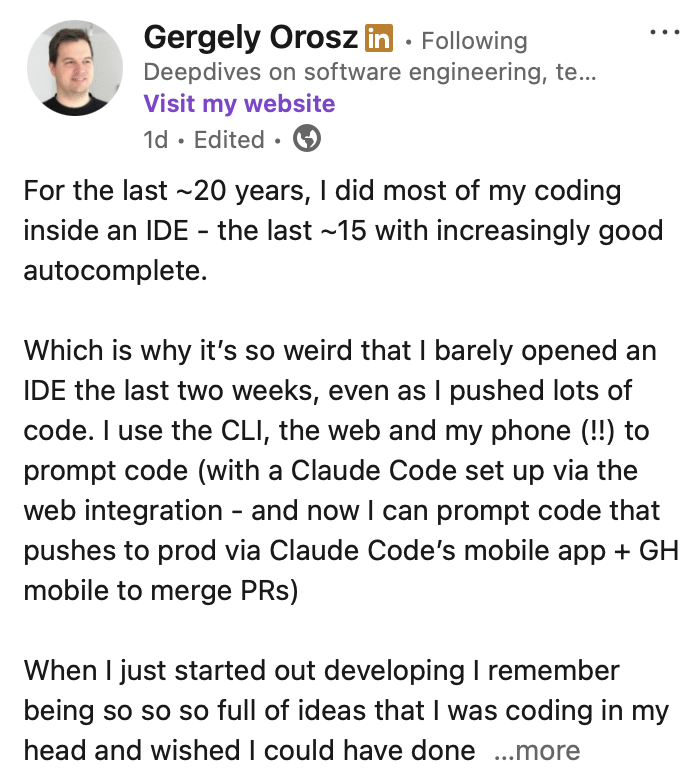
He mentioned that nowadays he barely even opens an IDE. Instead, he ships code using CLI agents, web interfaces, and even his phone. He can prompt code that pushes to production via Claude Code’s mobile app and merge PRs on GitHub mobile.
I assume he isn't staring at his phone the entire time while the agent is doing its magic, nor is he paying 100% attention to every line of generated code, especially when running several agents simultaneously.
I get it; this is "vibe coding" or rapid prototyping. But when did we stop needing deep thought for that? Isn’t it simpler and more effective to write down your thoughts first rather than just "machine-gun prompting"?
How does this shallow work compare with the deep work Cal Newport wrote about? Can we actually maintain deep focus in the gaps between prompts?
In my view, 2026 is going to be either the year of extreme context switching or the year people return to what actually works. I foresee more burnout and stress resulting from these long "vibe coding" sessions. Eventually, the hype will settle, and we'll realize that while the tools are faster, the human brain still requires depth to build things that last.